
7 Bluetooth Otoscope Buying Tips for Global Buyers

A Bluetooth Otoscope can make ear images easier to view and share, but a wireless connection alone does not guarantee a useful device. Global buyers should compare image clarity, lighting, app compatibility, battery life, comfort, and after-sales support. Small details matter: Can the image stay steady on a phone screen? Does the app work with the devices your team already uses? Are replacement tips easy to source?

This guide offers seven practical buying tips for comparing models across suppliers and markets. It focuses on specifications buyers can verify, questions worth asking, and trade-offs that product photos may hide. “A clear image is only valuable when the device is comfortable, dependable, and simple to use,” says [verified expert name], a [verified role or affiliation]. Replace this draft quotation with a source-checked statement before publication.

Look closely at how each feature performs in everyday conditions. A bright display may help in a dim room, while a bulky handle can make longer use less comfortable. Check whether the manufacturer provides clear instructions, app updates, and responsive technical support. Ask for product documentation and confirm that stated features match the model being quoted. No single specification tells the whole story. The right choice depends on intended users, compatible devices, purchasing requirements, and service expectations. These tips help buyers make a more informed comparison without treating a connected camera as a substitute for professional clinical judgment.
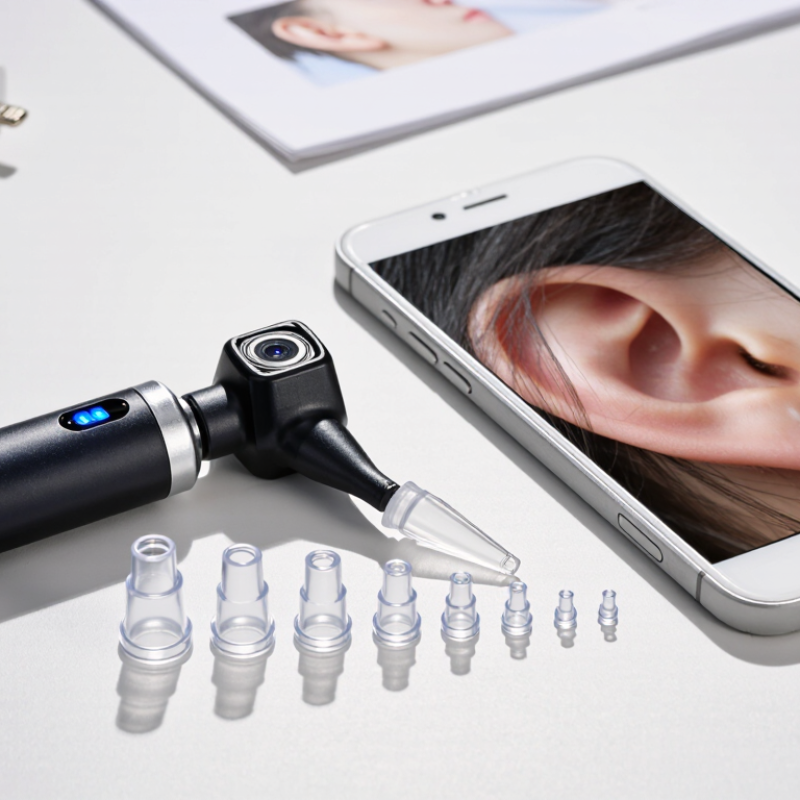
7 Bluetooth Otoscope Buying Tips for Global Buyers

Define Intended Use and Verify Applicable FDA or EU MDR 2017/745 Status

Before comparing image quality or battery life, define who will use the otoscope and where. A device for clinician examinations may have a different intended purpose from one marketed for home viewing. Write down the user, setting, patient group, and diagnostic claims you expect to make. Be specific. “For ear checks” is too vague to guide a reliable compliance review.

Then verify the regulatory status for each target market. In the United States, check the manufacturer’s stated FDA pathway and relevant public records; do not treat “FDA registered” as proof of clearance or authorization. In the European Union, review the device’s classification, applicable MDR 2017/745 requirements, EU Declaration of Conformity, and CE-marking evidence. A notified body may be required, depending on classification. Ask for documents that match the exact model and intended purpose, not a similar product. Check the connected app too, since its claims and functions can affect the assessment.

Keep evidence on file. That helps. Confirm labels, instructions, and online claims tell the same story. If a supplier says the product is suitable for diagnosis, ask what documentation supports that claim and for which markets. I have seen buyers focus on the camera while overlooking the software description. It is an easy detail to miss, and paperwork alone does not prove real-world performance. Evaluate image clarity and usability with intended users before placing a large order.

Compare Image Claims: 1080p Resolution Equals About 2.07 Megapixels

For global buyers comparing Bluetooth otoscopes, “1080p” has a precise pixel meaning. ITU-R Recommendation BT.709 defines a common HDTV raster as 1920 × 1080 pixels. Multiplying those dimensions gives 2,073,600 pixels, or about 2.07 megapixels. That figure describes the image grid, not how much fine detail the device actually resolves.

The distinction matters. A small lens, soft focus, uneven ear-canal lighting, or wireless compression can reduce visible detail, even when a listing says 1080p. The label alone is a weak answer. ISO 12233:2023 outlines methods for measuring digital-camera resolution and spatial-frequency response, offering a more meaningful reference than pixel count alone. Ask for an unedited sample image captured at the device’s native resolution. Check whether fine edges remain clear near the image corners, not only in the center. Compare samples under similar lighting and on the same display. This takes extra effort, and a single sample still cannot prove consistent performance. It is a useful check, though.

Check Live-Video Capacity: Bluetooth LE 2M PHY Peaks at 2 Mb/s

When comparing Bluetooth otoscopes, do not treat “2 Mb/s” as guaranteed video speed. The Bluetooth SIG Core Specification defines LE 2M PHY at a 2 Mb/s raw signaling rate. That is the radio’s peak, not the usable video payload. Packet overhead, interference, retransmissions, and phone processing all reduce real-world throughput.

Ask the supplier which link carries live video: Bluetooth, Wi-Fi, or another connection. Some devices use Bluetooth for pairing or controls while video travels over Wi-Fi. Small detail. Confirm that both the otoscope and phone support LE 2M PHY; otherwise, the connection may use a slower mode. Then test a sustained stream, not just a successful connection.

Watch for frozen frames while moving the probe, delayed images, or sudden drops in resolution. Try the test at the intended working distance, with a hand near the phone and ordinary room traffic nearby. These conditions are easy to overlook. Record frame rate and latency over several minutes, and request the test method behind any quoted speed. A sharp image in a short demonstration can still conceal unstable live viewing. Bluetooth SIG’s specification gives a useful ceiling, but it does not certify a product’s actual video performance.

Assess Ear-Tip Materials Against ISO 10993-1 Biocompatibility Guidance

A Bluetooth otoscope’s ear tip may look like a simple plastic cap. It still contacts delicate skin inside the ear canal. Ask suppliers for the exact material grade, colorants, additives, and processing details—not just “medical-grade” wording. That label alone does not establish biocompatibility. Small details matter.

ISO 10993-1:2018 frames biological evaluation around contact type and duration. The FDA’s 2023 guidance on applying ISO 10993-1 distinguishes limited contact (up to 24 hours), prolonged contact (over 24 hours to 30 days), and long-term contact (over 30 days). These thresholds help buyers assess the intended use; they do not automatically prove a tip is safe. Request the biological evaluation rationale and relevant test reports for the finished material, including evidence tied to skin contact. If tips are reusable, also review how cleaning and disinfection may affect the material. Ask for data after the stated reprocessing cycles, where applicable. A document for raw resin may not represent a molded, colored tip. That gap is easy to miss.

Compare supplier evidence against your actual use conditions: insertion depth, contact time, and whether users share or replace tips. Check that test samples match the production design. If the evidence is incomplete, pause and ask what remains unassessed. Perfect paperwork is rare. Clear limitations are better than confident guesses.

Review Manufacturer Quality Systems and IEC 60601-1 Safety Evidence

For a Bluetooth otoscope, check the manufacturer’s quality system and safety evidence together. A certificate alone is not proof that the unit you will receive was tested. WHO’s Global Atlas of Medical Devices reports more than two million types of medical devices, grouped into over 7,000 generic categories. That variety makes clear product identification essential. Ask for the quality-system certificate, its scope, covered factory address, and expiry date. Then match the model number on the certificate or test records to the otoscope, probe, charger, and power supply offered. Details matter.

Request IEC 60601-1 test evidence for the exact configuration, including the report’s issuing laboratory, test date, and any deviations. The standard addresses basic safety and essential performance; it does not, by itself, confirm Bluetooth security or image quality. Check that battery charging, electrical insulation, and temperature testing cover the supplied accessories. Also review how the manufacturer records complaints, corrective actions, and lot traceability. Ask for a sample traceability record, not just a policy statement. Look closely. A polished document can still leave gaps. One easy detail to miss is whether the audit covers the site assembling the device or only a separate corporate office. It is worth asking twice. If evidence is incomplete, ask what has not been tested and why. That answer can reveal more than a certificate.

7 Bluetooth Otoscope Buying Tips for Global Buyers — Review Manufacturer Quality Systems and IEC 60601-1 Safety Evidence

# Buying tip What to evaluate Evidence to request or check Why it matters
1 Review the quality management system Check whether the manufacturer operates a medical-device quality system appropriate to the product and intended markets. Confirm the certificate’s scope, sites, and validity. Current quality-system certificate, scope statement, issuing body details, and—where available—an audit summary or supplier-quality process description. ISO 13485 is a widely used medical-device QMS standard. A certificate is useful evidence of a controlled quality system, but it does not by itself establish that a particular otoscope is safe, effective, or authorized in every market.
2 Check IEC 60601-1 safety evidence Confirm that testing covers the exact device configuration, power source, accessories, and intended use. Ask which edition and national deviations were applied. Complete test report or a verifiable certificate with the report number, model identifiers, test laboratory, applicable edition, and any limitations or deviations. IEC 60601-1 addresses basic safety and essential performance of medical electrical equipment. A claim or certificate should be checked against the specific model and relevant market requirements.
3 Ask about related safety and EMC testing Determine whether electromagnetic compatibility and the actual use environment have been assessed. Home-use equipment may require additional consideration beyond a clinic environment. Relevant IEC 60601-1-2 EMC test evidence; where the intended use calls for it, evidence addressing IEC 60601-1-11 requirements for medical electrical equipment used in the home healthcare environment. IEC 60601-1 is a general standard; applicable collateral standards and national adoption requirements depend on the product and intended use.
4 Verify optical, lighting, and thermal performance Assess image clarity, field of view, illumination consistency, focus, temperature rise, and performance across the stated operating conditions. Product specifications, verification or validation summaries, temperature and illumination test results, and sample-unit evaluation using the intended phone or display. Useful images and controlled illumination support examination, while testing helps identify practical limitations such as glare, heat, or inconsistent focus.
5 Test Bluetooth compatibility and connection behavior Check supported Bluetooth version and profiles, supported operating systems and device models, pairing steps, reconnection behavior, and performance in environments with wireless interference. Compatibility matrix, connection and range test methods, user instructions, and—where Bluetooth qualification applies—an entry that can be checked in the Bluetooth SIG listing database. Bluetooth performance depends on both the otoscope and the receiving device. A qualification record does not guarantee compatibility with every phone or application.
6 Review software, data handling, and updates Clarify where images and account data are stored, whether cloud services are used, how access is controlled, and how software updates and vulnerabilities are managed. Software version history, privacy and data-flow documentation, security update policy, backup and deletion procedures, and a description of supported phone operating systems. Image capture and wireless transfer can involve sensitive health information. Data protection obligations vary by jurisdiction and deployment model.
7 Confirm market access, traceability, and service support Match regulatory documentation to the intended country, device classification, intended purpose, labeling, and importer or distributor responsibilities. Applicable market authorization or conformity documentation, label and instructions for use, lot or serial-number traceability, complaint and recall process, warranty terms, and spare-parts availability. Regulatory pathways differ by market. Evidence for one country or configuration should not be assumed to establish access in another.

Buyer note: Standards, certification routes, and regulatory obligations depend on the device’s intended purpose, configuration, and target market. Verify current requirements with the relevant authority or a qualified conformity-assessment professional.

Go to Top