

Top 10 Types of RT PCR Tests Buyers Should Know
Rt-Pcr testing covers several methods, not one interchangeable product. A buyer comparing kits may encounter one-step and two-step workflows, multiplex panels, endpoint assays, and real-time quantitative tests. Each choice affects sample handling, turnaround time, instrument needs, and the kind of result reported. A neat label can hide important differences.
Stephen A. Bustin, a molecular diagnostics researcher and qPCR specialist, has emphasized transparent methods: “The MIQE guidelines are intended to help authors design experiments and report data in a transparent manner, so that the reviewer and reader can assess the validity of the results.” That principle matters when evaluating assay documentation. Buyers should check target coverage, controls, analytical performance, sample compatibility, and whether the test is validated for its stated use. A bright fluorescence curve alone is not enough.
This guide introduces ten common types of RT-PCR tests and explains what distinguishes them. It also considers practical trade-offs, such as whether a one-step workflow saves time or limits flexibility. Some distinctions are less tidy than product pages suggest. Test names can overlap, and performance depends on the assay, sample, and laboratory process. Use the categories as a starting point, then verify technical claims against the manufacturer’s documentation and your own testing requirements.
How RT-PCR Tests Detect RNA and Produce Results
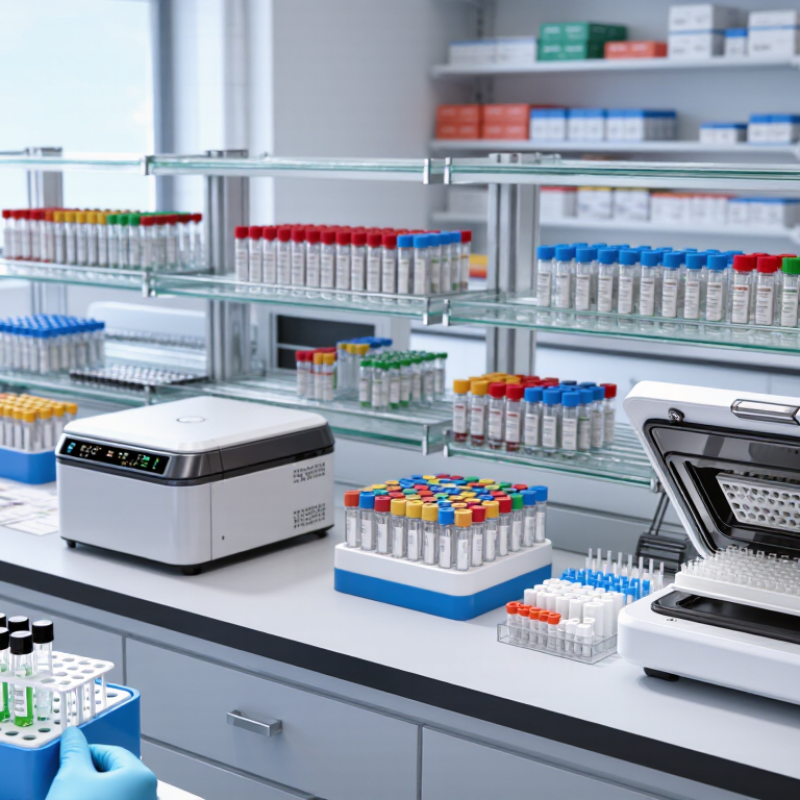
RT-PCR tests look for RNA in a collected specimen, such as a nasal swab or saliva sample. In the lab, technicians extract genetic material and prepare it for testing. Because standard PCR copies DNA, reverse transcriptase converts target RNA into complementary DNA. Primers then guide repeated copying of selected genetic regions. Specificity matters.
During amplification, instruments monitor fluorescent signals as target material is copied. A signal crossing the test’s threshold supports detection of the chosen RNA target. If no signal appears, the result may be reported as not detected, provided required controls perform correctly. Controls can help identify extraction failures or contamination.
The result is not a perfect snapshot of infection. Timing, sampling quality, transport conditions, and assay design can affect detection. A weak signal may appear late in the cycle, but cycle-threshold values are not directly comparable across different tests. That nuance is often missed. Results should be considered alongside symptoms and clinical guidance, especially after recent exposure or when a sample was difficult to collect.
Top 10 Types of RT PCR Tests Buyers Should Know - How RT-PCR Tests Detect RNA and Produce Results
RT-PCR first uses reverse transcriptase to convert RNA into complementary DNA (cDNA), then amplifies selected DNA sequences. The categories below describe different assay designs and reporting approaches; they can overlap rather than representing ten mutually exclusive test types.
| Type | How It Works | Typical Result | Useful For | Buyer Considerations |
|---|---|---|---|---|
| 1. One-step RT-PCR | Reverse transcription and PCR amplification take place in the same reaction tube. | An amplified target, detected in real time or at the end of the reaction, depending on the assay. | Routine workflows where fewer handling steps and reduced tube transfers are priorities. | Check that the enzyme and reaction chemistry suit the target and sample. The cDNA is generally not available for separate downstream assays. |
| 2. Two-step RT-PCR | RNA is reverse-transcribed in a separate reaction; the resulting cDNA is then used in one or more PCR reactions. | Amplification results from the selected PCR assay or assays. | Studies testing multiple targets from the same cDNA preparation or using cDNA in follow-up work. | Offers flexibility but adds handling steps and potential for contamination. Include the extra preparation time when planning workflow. |
| 3. Probe-based real-time RT-PCR | A target-specific fluorescent probe generates signal during amplification, which an instrument measures cycle by cycle. | A fluorescence amplification curve and, commonly, a Cq/Ct value for a detected target. | Target-specific detection and assays that need to distinguish multiple targets with separate fluorescent channels. | Requires a probe designed for the target. Confirm instrument channel compatibility and that the assay has been validated for the intended use. |
| 4. Dye-based real-time RT-PCR | A fluorescent dye binds double-stranded DNA, and signal is monitored as amplified DNA accumulates. | A fluorescence curve and Cq/Ct value; a melt-curve analysis may be used to assess the amplified product. | Cost-conscious, usually single-target assays where post-amplification melt analysis is appropriate. | The dye can also report nonspecific double-stranded products, so assay specificity and controls are important. It is generally less suited to multiplexing than probe-based detection. |
| 5. Multiplex real-time RT-PCR | Two or more target sequences are amplified in one reaction, typically using distinguishable fluorescent probes. | Separate signals for the included targets and, when designed, an internal control. | Testing several targets in one sample while conserving sample volume and reaction capacity. | Check the instrument’s available channels, target compatibility, and validation data. Multiplex performance can be affected by competition between reactions. |
| 6. Singleplex real-time RT-PCR | One target is measured per reaction using real-time fluorescence detection. | A target-specific amplification curve and Cq/Ct value, if the target is detected within the assay’s validated range. | Focused testing, assay development, or situations where independent target reactions are preferred. | Compare the number of reactions required per sample with a suitable multiplex option. Cq/Ct values alone are not a universal measure of RNA quantity across different assays. |
| 7. Endpoint RT-PCR | After reverse transcription and amplification, the PCR product is assessed at the end of the reaction, often by gel electrophoresis. | A visible product of an expected size or another endpoint signal; standard endpoint results are usually qualitative or semi-quantitative. | Presence-or-absence checks and applications where real-time quantification is not required. | Post-PCR handling can increase contamination risk. Endpoint signal is not equivalent to a validated quantitative RNA measurement. |
| 8. Relative-quantification RT-qPCR | Target Cq/Ct values are compared with a reference gene and a calibrator sample; methods such as ΔΔCq can estimate relative expression. | A relative expression value or fold change, rather than an absolute number of RNA copies. | Comparing gene expression between samples or experimental conditions. | Reference genes must be appropriate and stable for the samples. The calculation also relies on suitable assay performance, including comparable amplification efficiencies for common ΔΔCq use. |
| 9. Standard-curve absolute-quantification RT-qPCR | Sample Cq/Ct values are compared with a dilution series of standards with known concentrations or copy numbers. | An estimated target quantity within the range supported by the standard curve and assay validation. | Applications requiring a concentration or copy-number estimate using a defined standard and calculation method. | Standard quality, dilution accuracy, extraction recovery, and the stated reporting units affect interpretation. Results are not directly comparable across different validated methods without appropriate controls. |
| 10. Reverse-transcription digital PCR (RT-dPCR) | RNA is reverse-transcribed, and the PCR reaction is partitioned into many individual reactions. Target-positive partitions are counted and used to estimate concentration, commonly with Poisson statistics. | An absolute concentration estimate within the assay’s validated range, generally without relying on a standard curve for quantification. | Applications where partition-based counting or absolute quantification is valuable. | Assess instrument and consumable requirements, partition counts, controls, and validated limits. Reverse-transcription efficiency and sample quality still affect RNA measurements. |
How to compare results: A positive or negative call, Cq/Ct value, relative expression value, and absolute concentration are different types of outputs. For any assay, review its intended use, sample type, controls, validated detection range, and reporting units. Total turnaround time varies with sample preparation, extraction, instrument workflow, and laboratory procedures.